 Symbi Biological
Cricket Castle and Cricket Baby Houdinis
The cricket population is exploding and we needed a room to house all the bins. I found an indoor gardening tent that is 10’x10′ and set it up. It’s working out really well. The biggest surprise so far has been the cricket babies ability to escape the bins! Like little Houdinis! They crawl up the sides and sneak out the top edge. They’re so small they can fit right under the lip of the lid and make a break for it. I’ve been keeping a kohlrabi outside the bins for them to collect on it since that is the only food outside their habitats. I just pick it up and blow on it over the bins to get them safely back inside. I’m going to modify a shop vac to gently vacuum them up and will have a post about that soon. Until then, I’m continually corralling crickets.
Aquaponics Redesign Revisited

It’s been a couple weeks since making the changes to the filtration in the system. We used to have a clarifier with a baffle which truly provided baffling clarification. It didn’t really do a good job of filtering out the solids and my net tank was getting funky fast. After consulting with Jon Parr of Schoolgrown, we decided to switch to a Swirl Filter. Initially, it looked like it was more effective than the original clarifier with the baffle. I was pretty excited. However, Jon mentioned that I might want to consider a bigger pump as my velocity coming into the Swirl Filter may not be enough. As usual, Jon was right. Since our swirling was so slow, the solids were also collecting in the net tank instead of the Swirl Filter. This collection slowed the total flow of the system down and exacerbated the problem. I added a second pump to the the sump combining it with the original pump to double up the flow and get more swirly action. This appears to have boosted my flow rate back up to around 7-8 gpm. I may need to just get a bigger pump altogether, but figured I’d use what I have on hand and monitor the results. Will keep you posted how it performs over the next couple weeks.
Cricket or the Egg?
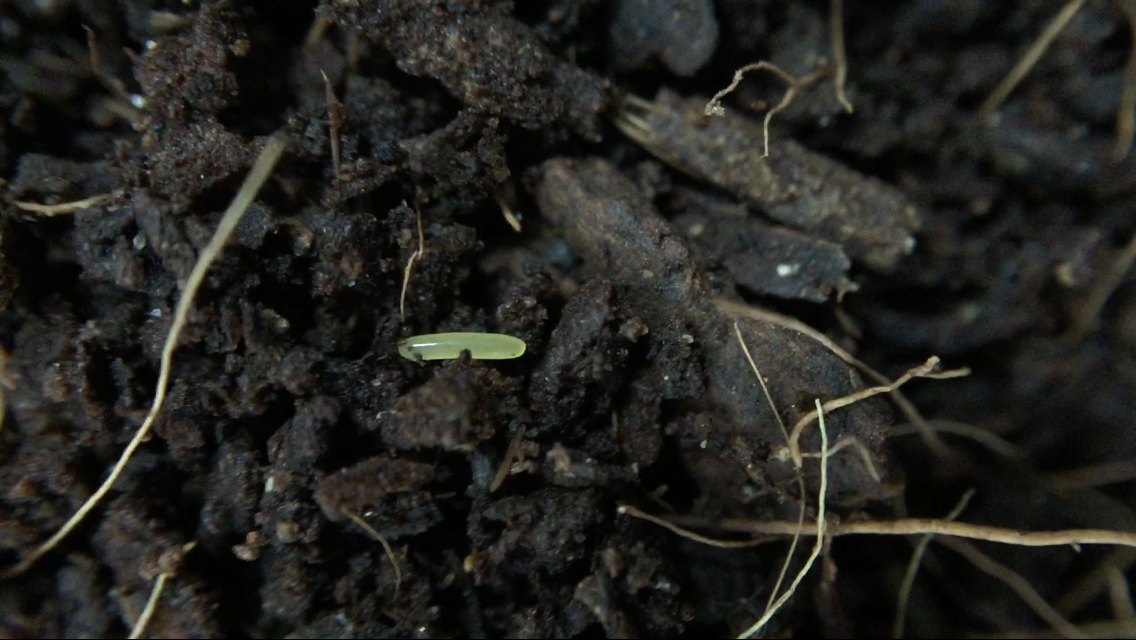
In our case, the cricket definitely came before the egg. For awhile there, I couldn’t even see the eggs they’re so small! The baby crickets just kind of showed up and I completely missed the eggs in the first habitat due to dim lighting. Now I have a little T5 fluorescent light that makes them glow as if Orcs were nearby! Very easy to see. This is great because the older crickets can eat the eggs and babies so its important to get them in their own habitat as soon as possible to keep the population strong. Here’s some photos of what an egg looks like and a bonus baby photo because they’re so darn cute! Click on the photos to enlarge.


That’s a lotta larvae!
Walking past a pile of partially composted horse manure, I noticed the pile was moving. Going in for a closer look, I found a heck of a lot of larvae. I wasn’t too sure what they were so I contacted UC Davis. Lynn Kimsey was super helpful and looked at some photos and then I sent in a sample just to be sure. They turned out to be Crane Flies!
Aquaponic Filtration Redesign
Last week, we were lucky enough to have our friend Jon Parr of SchoolGrown come by for a visit. I had mentioned that our system design didn’t filter the water as nicely as I’d hoped. He suggested a swirl filter instead of the baffled clarifier we had originally installed. As much as I always enjoyed saying to folks that we have baffling clarification, I was ready to make the change. We made some adjustments and combined the two tanks to feed the new swirl filter, which happens to be the old clarifier with the baffle removed and a 45 degree elbow pointed sideways as the inlet to create the swirl. It seems to work better than the baffle. Thanks, Jon!
Crickets Eat Spirulina!
Well this is fantastic. I put some spirulina in the cricket bin hoping that they would eat it. And they did! It will be interesting overtime to play with the amounts and blend it in with other feedstocks. Looking forward to growing the colony to test out different mixes.
Two Week Old Crickets
It’s only been two weeks and the crickets are getting much bigger. I can’t believe how many there are! There are some larger ones and some really small ones. I am supplementing the apple slices with a little cricket feed, which looks a lot like chicken feed. I don’t put much of the cricket feed in there trying to rely mostly on the apples. My guess is the bigger crickets are the ones getting the extra protein leaving the little guys out. When the colony grows and I can get more bins together, we’re going to test this hypothesis as uniform cricket production is the goal for a couple reasons. First, they are easier to harvest and process being close to one size. Secondly, I’m betting there is less incidence of cannibalism if the crickets are all similar size. The big ones in the current bin are probably going to eat some of the smaller ones. 😦
I’m excited to see how they perform on a spirulina and aquaponics veggie diet and some other combinations we can offer them.
They Grow Up So Fast!
Gosh, they really do grow up fast don’t they? The crickets went from tiny little specks to actual crickets pretty quick. Take a look!
Baby Crickets!!!
When I opened the cricket habitat today, I was surprised to see some little critters scurrying about. At first, they looked like an army of ants, but a closer look revealed they are baby crickets! Since we’ve added some heat mats to the side and bottom of the habitat, they have not had the large temperature swings like the days before. Happy crickets make baby crickets! As you can see, the babies are very small and incredibly hard to film. Seems like when I get one in focus, they realize it and scram. Limited footage aside, my friends at Bitwater Farms are going to be so proud! One step closer to fish food.
Pupae Still Waiting
Today, when I walked into the Insectary (our greenhouse), I saw about a dozen or so of the pupae crawling round the flat of compost that I set out for them. They’ve been hiding out in there all winter as we’ve seen in previous posts. I’ve been adding a little water here and there so the compost doesn’t dry out. It seems everytime it dries out, they come up from below. At this point, we know we need a better environment than what we are providing for the soldier flies to breed. For the next BSFL project, we’re going to need to add some more heat and control the humidity better than our simple system. The whole point of what we do is to see if we can do something as low tech as possible. That way, anybody can replicate it. We’re going to have to get just a wee bit more sophisticated to get a BSFL colony going it appears.
 Symbi Biological
Recent Comments